Rethinking AI and its Impact on Business and Humanity
Artificial Intelligence has become one of the defining topics in hospitality, with organisations investing heavily in new technologies and exploring how AI can improve commercial performance. Yet, according to Daniel Hulme, many businesses are still asking the wrong questions.
Rather than seeing AI as another tool for producing reports, dashboards or predictions, Daniel argues that its real value lies in helping organisations make better decisions. It’s a subtle but important shift in thinking, one that has the potential to change how businesses approach everything from revenue management to guest experience.
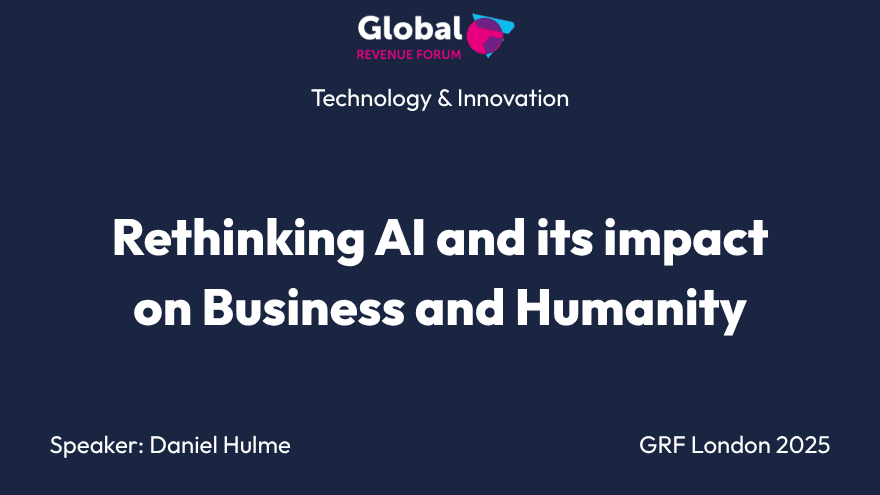
In his keynote at Global Revenue Forum London 2025, Daniel explores what intelligence really is, why organisations often misunderstand AI, and how leaders can prepare for a future where humans and machines work together in very different ways.
We don’t have data problems. We have decision problems.
Many organisations begin their AI journey by trying to collect more data. The assumption is that more information will naturally lead to better decisions.
Daniel challenges this idea.
Businesses rarely struggle because they don’t have enough data. More often, they struggle because they don’t know how to turn that information into consistent, high-quality decisions.
Traditional business intelligence tools are designed to help people interpret information. AI, however, offers the opportunity to move beyond reporting and support adaptive decision making at scale.
The objective shouldn’t be to produce more dashboards. It should be to make better decisions, faster and more consistently.
Intelligence is about adaptation
One of the central ideas in Daniel’s presentation is his definition of intelligence:
“Goal-directed adaptive behaviour.”
Rather than thinking of intelligence as knowledge or information, he encourages us to think about the ability to adapt.
Whether it’s a person, an organisation or an AI system, intelligence is demonstrated through the ability to respond to changing environments while continuing to move towards a desired outcome.
For hospitality businesses operating in increasingly complex and unpredictable markets, this way of thinking feels particularly relevant.
AI should augment people, not replace them
Much of the public conversation around AI focuses on automation and job replacement.
Daniel takes a more balanced view.
The greatest opportunity isn’t replacing people. It’s enabling people to spend more time on the work that humans do best, such as creativity, collaboration, empathy and strategic thinking.
AI is exceptionally good at processing vast amounts of information and identifying patterns. Humans remain essential for setting objectives, applying judgement and understanding context.
The future isn’t about choosing between humans and machines. It’s about understanding where each creates the greatest value.
Rethinking commercial strategy
For commercial teams, this represents a significant change in mindset.
Instead of asking: “How can AI give us more insights?”
Perhaps the better question is: “Where are the decisions in our business that AI could help us make better?”
That shift moves AI away from being simply another reporting tool and positions it as part of the decision-making process itself.
Whether that’s forecasting demand, managing pricing, personalising the guest journey or supporting operational decisions, the focus becomes outcomes rather than technology.
Looking ahead
AI continues to evolve at remarkable speed, but Daniel’s keynote reminds us that successful adoption isn’t about chasing the latest technology.
It’s about understanding the problems we’re trying to solve.
By focusing on decision making, adaptability and collaboration between humans and AI, hospitality businesses can move beyond experimentation and begin creating meaningful commercial value.
As the industry continues to evolve, those organisations that embrace this way of thinking are likely to be better prepared for whatever comes next.