The Booking Happened on Google. But Where Was the Value Created?
Hotels have become very good at measuring where bookings happen. We know which channel delivered the conversion. We track clicks, bookings, conversion rates and return on advertising spend. We compare the cost of direct business with OTA commissions and invest more in the channels that appear to perform. But what if the channel that receives [...]
Hotels have become very good at measuring where bookings happen.
We know which channel delivered the conversion. We track clicks, bookings, conversion rates and return on advertising spend. We compare the cost of direct business with OTA commissions and invest more in the channels that appear to perform.
But what if the channel that receives the booking is not the channel that created the demand?
A guest may click on a Google ad today and make a direct booking. But their decision to choose that hotel may have started much earlier.
Perhaps they watched a video six months ago. Saw the hotel on social media. Read about the destination. Encountered the brand several times. Or simply developed a preference that eventually led them to search for that particular hotel.
Suddenly, a seemingly straightforward question about attribution becomes much more complicated.
Are hotels measuring the wrong moment?
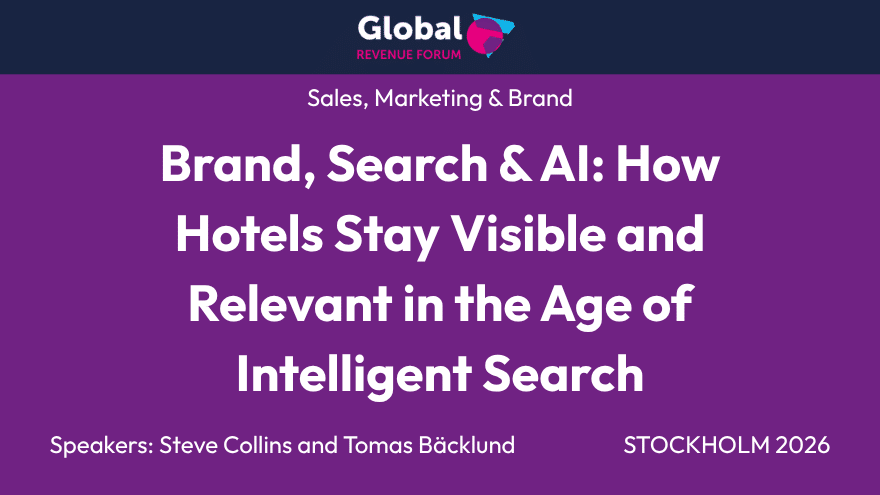
At Global Revenue Forum Amsterdam, we brought together two very different perspectives on this question.
Tuomas Backlund, CMO of Elite Hotels of Sweden, approaches it from the world of brand. Steve Collins, VP Digital Marketing at The Access Group, approaches it from digital marketing, technology and search.
Their conversation started with AI, but quickly became something much broader.
What is the role of brand when hotels are increasingly focused on measurable performance?
When does the decision to book actually begin?
And if Google ultimately captures the conversion, how much of the value was created somewhere else?
One of the challenges raised during the conversation is that the activities closest to the booking are often the easiest to measure.
Brand building is harder.
Inspiration is harder.
The effect of a video someone watched months before travelling is harder.
Yet difficult to measure does not necessarily mean unimportant.
And now search itself is changing
AI adds another layer to the question.
For years, hotel marketers have worked to understand how guests search and how their hotels can become visible at the right moment.
But what happens when search becomes more conversational?
What happens when travellers increasingly ask technology to recommend, compare and eventually help plan their trip?
And what determines which hotels appear in those answers?
During the session, Steve looks at how Google’s search ecosystem is evolving and what that could mean for hotel visibility, while Tuomas brings the conversation back to a fundamental commercial question: however sophisticated the technology becomes, hotels still need to give people a reason to choose them.
Brand, search and AI are not separate conversations
Perhaps that is where this becomes particularly interesting.
Brand creates preference.
Search captures intent.
Technology increasingly influences discovery.
But the guest experiences one journey, not three separate marketing strategies.
Understanding how those elements connect may therefore become one of the more important commercial questions for hotels as search continues to evolve.
And it leaves us with a question worth considering:
Are we measuring where the booking happened, or understanding where the value was created?