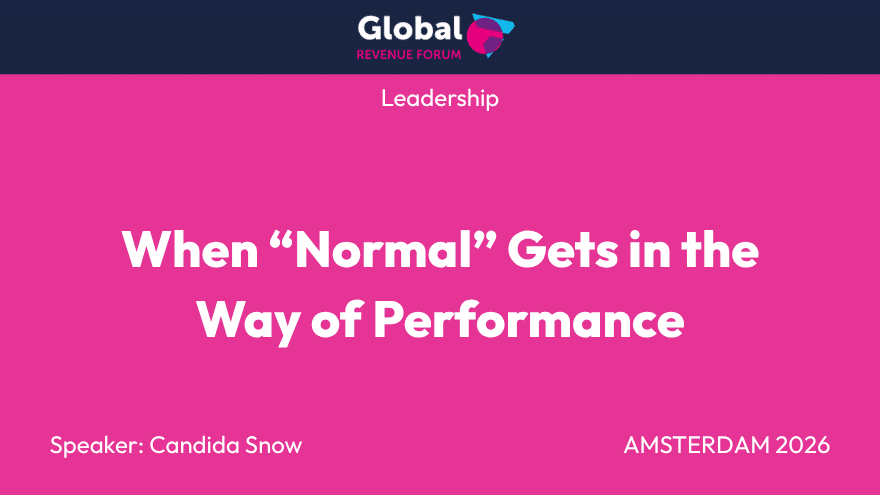
When “Normal” Gets in the Way of Performance
We all know what good leadership looks like. Until we work with someone whose definition of good leadership is completely different from our own. Hospitality is one of the most international industries in the world. Our colleagues, guests, owners and business partners come from different countries and backgrounds. We work across borders every day. [...]
We all know what good leadership looks like. Until we work with someone whose definition of good leadership is completely different from our own.
Hospitality is one of the most international industries in the world.
Our colleagues, guests, owners and business partners come from different countries and backgrounds. We work across borders every day. Yet simply working internationally does not automatically make us culturally intelligent.
At Global Revenue Forum Amsterdam, Candida Snow challenged the audience to look beyond the visible differences between cultures and examine something much more difficult to recognise: the cultural assumptions that shape what we consider normal.
Because the challenge is rarely that we do not see behaviour.
The challenge is how we interpret it.
We do not see the world as it is
Early in her keynote, Candida divided the audience into two groups and showed them different images. When both groups were subsequently shown the same ambiguous image, one group predominantly saw a man. The other saw a mouse.
Same picture. Different reality.
The exercise illustrated a simple principle: we tend to see what we expect to see, based on what we already know.
Culture works in much the same way.
Across the world, we recognise concepts such as good leadership, teamwork, respect, effective communication, deadlines and productive meetings. But what those concepts look like in practice can be very different.
Our cultural background becomes a lens through which we interpret behaviour.
And because that lens feels normal to us, we often do not realise that we are wearing it.
The problem with stereotypes is not only that they simplify
Candida makes an important distinction.
We do not work with cultures. We work with people.
Every individual has a personality, experiences and preferences of their own. Yet when we encounter people from another cultural background, we have a tendency to reduce the individual to the group.
The Dutch are direct. The English drink tea. The Spanish take siestas.
Stereotypes may originate in patterns we have seen, heard about or experienced. The problem begins when we use our own cultural lens to assign meaning to those patterns.
Take Dutch directness.
To somebody accustomed to a less direct communication style, the behaviour may feel blunt or even rude. Ask a Dutch person about the intention behind it, however, and words such as honesty, efficiency, helpfulness and clarity emerge.
The behaviour has crossed cultures.
The intention has not necessarily crossed with it.
That gap between intention and interpretation is where a great deal of international misunderstanding begins.
When good leadership looks like bad leadership
This becomes particularly important for leaders.
Candida asked the audience a deceptively simple question:
Should a good leader have most of the work related answers for the team?
Research she presented showed dramatically different responses between cultures. In Sweden, only 10% of respondents agreed. In Japan, the figure was 78%.
Neither response tells us which culture has discovered the secret to good leadership.
It tells us that competence, trust and professionalism can be recognised differently depending on the cultural lens through which we are looking.
In cultures where hierarchy tends to be relatively low, the good leader may position themselves almost as one of the team. Their role is to enable and support. They trust people to work independently and make themselves available when needed.
The familiar leadership message is: My door is always open.
In cultures with a stronger expectation of hierarchy, good leadership can look different. The leader is expected to be more visible, provide direction, protect the team and have answers.
Now put those two people in the same organisation.
A manager who believes they are demonstrating trust by giving people autonomy may be perceived as weak, uninterested or unavailable.
A manager who believes they are demonstrating care by providing close guidance may be perceived as controlling, micromanaging or distrustful.
Both may be competent leaders.
Both may have positive intentions.
And both can be completely misread.
Are they disengaged, or are they showing respect?
The same dynamic enters the meeting room.
In some cultures, engagement means speaking up. Ask questions. Challenge ideas. Think critically out loud. Take the floor.
That behaviour communicates: I am here. I care. I am contributing.
Through another cultural lens, exactly the same behaviour can appear chaotic, disrespectful or dominating.
And the reverse is equally important.
Someone who listens carefully and waits until they are invited to speak may be demonstrating engagement and respect. Through a different cultural lens, their silence can be interpreted as disinterest, lack of ideas or lack of confidence.
This matters in international hospitality organisations.
Who gets heard in a meeting? Who is considered leadership material? Whose ideas are noticed? Who is labelled proactive, difficult, passive or confident?
Sometimes we may believe we are assessing the individual when we are actually assessing how closely their behaviour matches our own definition of normal.
Even motivation is culturally coded
Culture can also influence what recognition and success look like.
Candida asked the audience to remember school. Were the highest performing students publicly recognised with prizes, certificates, published results or other signs of achievement?
For some people, excelling above others is something to celebrate. That thinking can continue into professional life through individual targets, bonuses, promotions, rankings and public recognition.
In other cultures, including the Dutch example Candida explored, the emphasis can be different: doing your best, contributing to the group and avoiding placing one individual too prominently above others.
Neither automatically creates better performance.
But the difference raises an important question for international hospitality businesses:
Are we motivating people in the way we think should motivate them, or in the way that actually motivates them?
The same question applies to performance reviews, incentive structures and recognition programmes.
And then there is feedback
Perhaps one of the most memorable examples in Candida’s keynote was the feedback sandwich.
In one communication culture, the sandwich contains plenty of positive reinforcement around a relatively small amount of improvement feedback. The intention is to motivate.
Then came Candida’s Dutch version.
A little positive feedback followed by what she called a “meatball of improvement points.”
Interestingly, the intention can still be supportive.
If I care about your development, why would I withhold all the things that could help you improve?
Yet move that feedback style across cultural boundaries and the helpful manager can suddenly appear relentlessly negative. Move the more positive style in the opposite direction and the recipient may struggle to work out what they are actually supposed to improve.
Again, the intention and the interpretation have separated.
Cultural intelligence is not about memorising nationalities
This is perhaps the most important distinction in Candida’s argument.
Cultural intelligence is not a catalogue of rules telling us what Dutch, Swedish, Spanish, Japanese or British people are like.
That would simply replace one set of stereotypes with another.
It is the ability to recognise that culture may be influencing a situation, to question our automatic interpretation and to adapt when appropriate.
Candida describes Cultural Intelligence, or CQ, as a set of competencies and skills that can be learned. The goal is to become more effective, appropriate and comfortable in intercultural business situations.
And that makes cultural intelligence highly practical.
When someone’s behaviour frustrates us, we can ask whether we are judging the behaviour or the intention behind it.
When somebody stays silent in a meeting, we can create another way for them to contribute.
When a team member reacts unexpectedly to feedback, we can examine not only what we communicated, but how it was decoded.
When leadership is not landing as intended, we can question whether the problem is necessarily the leader—or whether different expectations of leadership are colliding.
Take off the cultural glasses
Hospitality spends enormous amounts of time discussing technology, data, AI and commercial performance.
But all of those tools are ultimately used by people.
And people interpret.
That is why cultural intelligence is more than an HR or leadership topic. It influences collaboration, decision making, communication, motivation and the ability of international teams to perform.
The goal is not to remove our cultural lenses. We probably cannot.
The goal is to become aware that we are wearing them.
As Candida Snow reminded the audience at the end of her keynote:
“Not everything is culture, but it’s everywhere.”
Perhaps the most useful question the next time someone’s behaviour does not make sense is therefore not:
Why are they doing that?
But:
What might I be seeing through my own definition of normal?